Nonprofit policy decisions vs operational decisions nonpofit management

Should Mature Nonprofits Allow Board Micromanagement?

Should Mature Nonprofits Allow Board Micromanagement?

By: Eugene Fram

Viewer Favorite:  Updated and Enhanced

Accepted View of Micromanagement: “…Directors spend more time with the details of the operations instead of planning its short-term and long-term growth strategies. …
(http://linkd.in/1q84pMm)

The Need for a Micromanaging Board
Board micromanagement is an appropriate approach when a nonprofit is in a start-up stage. Financial and human resources are modest, and the volunteer directors must assume some responsibilities normally executed by compensated staff. The chief executive often has managerial responsibilities as well as a list of clients to service. It is not unusual to promote a person who is only familiar with direct service to become the first chief executive of the organization. In turn , this neophyte manager has to depend on board members for managerial counsel and direction. A culture of board dependency is created out of necessity.

(more…)

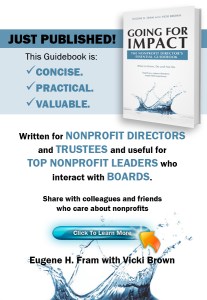
Going For Impact–The Nonprofit Director’s Essential Guidebook: What to Know, Do and Not Do based on a veteran director’s ample field experience

Helps board members to lead wisely, effectively and efficiently.

approved_Fram_Guidebook-emailer

Save

Save

Who is Primarily Accountable for Long Term Planning – Board or CEO?

Who is Primarily Accountable for Long Term Planning – Board or CEO?

By: Eugene Fram

THE QUESTION

Can you further clarify whom you see as accountable for making what decisions in relation to the various aspects of corporate strategy creation and execution? If the board approves the CEO’s decisions do they not become board decisions? Where is the scope for the CEO to be accountable for making his or her own decisions?

MY ANSWER
“(My model)… promotes accountability. It requires the board and the CEO to work together to paint the big picture for the organization. It then holds the CEO accountable for implementing that vision. The (board’s) planning and resource committee (also) plays a major part in painting this picture by helping the organization and the CEO to look ahead to look to the future.”

Now for some details also found in “Policy vs. Paper Clips. * (http://amzn.to/eu7nQl) (more…)

CEOs Need To Develop Partnering Relationships With Board Members


CEOs Need To Develop Partnering Relationships With Board Members

By Eugene Fram               Free Digital Image

When a CEO publicly introduces a board member as “my boss,” (as I have overheard more than once) there is a problem. It’s true that both parties—CEO and board member—have specific roles in the success of a nonprofit organization. But the hierarchy of authority should be deemphasized when it comes to interpersonal connections. The most effective mindset for CEO and directors is to view each other as partners in working to achieve the organization’s mission and their impacts.

The CEO’s efforts to cultivate such relationships are key. The following are some initiatives that he/she can utilize: * (more…)

Can Groupthink Hamstring Change on a Nonprofit Board?

Can Groupthink Hamstring Change on a Nonprofit Board?

By: Eugene Fram

Dictionaries typically define groupthink as “…the lack of individual creativity, or a sense of personal responsibility that is sometimes characteristic of group interaction.” In my opinion, the process is as lethal to the nonprofit board as smoking can be for humans. It ties boards to past experience and discourages experimentation. Since many nonprofit charters require boards to “conserve assets” and board members are characteristically volunteers, the nonprofit culture inevitably defers to groupthink–it’s in their DNA! “One goes along to get along.”
(more…)

Can A Board Member Ever Wear Two Hats?

Can A Board Member Ever Wear Two Hats?

By Eugene Fram

Although this is not a good idea for nonprofit organizations, it is not an unusual occurrence, especially among start-ups. A director in a start-up nonprofit will need to assume some staff responsibilities as a volunteer. But he/s will need to organizationally report to the CEO. (more…)

The Nonprofit Dream Team: a Board/CEO Partnership that Works!

The Nonprofit Dream Team: a Board/CEO Partnership that Works!

By: Eugene H. Fram

Re-balancing and maintaining important relationships in a nonprofit organization can be important to its success. Do various players fully understand and accept their specific roles. Is there mutual trust between players? Are communications open and civil?

I recently encountered an association CEO who complained that his board wanted to judge him without establishing mutually agreeable goals, outcomes or impacts. He felt what is needed is a partnership arrangement where the board does not judge the CEO and organization based on political or personal biases but overviews the two in terms of mutually accepted achievements. This, he contended, forms a substantial partnership between board and CEO and staff. If the board thinks it can judge management, he stated, it gives it a personal political type of power, unrelated to performance. As an example he pointed to an unfortunately common nonprofit situation where a CEO is given an excellent review and fired six months later because there had been a change in the internal board dynamics. (more…)

Can Nonprofit Management Usurp Board Responsibilities?

Can Nonprofit Management Usurp Board Responsibilities?

By Eugene H. Fram

On balance management will always have more information about the organization than volunteer board members. As a result, directors must be proactive in seeking information from management and a variety of other sources, even if they must involve employees other than senior management. Following are three field examples showing what has happened when boards failed to be proactive (more…)

Falling in Love With the Mission & Other Sage Advice for a First Time Nonprofit Director

Falling in Love With the Mission & Other Sage Advice for a First Time Nonprofit Director

By: Eugene Fram

Sam Smith recently entered early retirement and wants to become a director on the board of a nonprofit organization. His motive is to give back to the community where he has prospered. As a first time board member, he can look to some advice from pros in the area, from a recently published article by Stanford’s Center Social Innovation (CSI).
http://stanford.io/1qefmx1

Following are my reactions to some of the article’s suggestions, hopefully adding important field information. The comments are based on having served on 12 nonprofit boards over several decades and my experiences as a consultant to at least a dozen additional nonprofit boards.

Fall in Love Wisely
This is good advice. It follows the nonprofit dictum that each director needs to be dedicated to the organization’s mission. In practice, however, some flexibility is required:
• the availability of choices at the time the search for the position takes place
• the board ‘s current composition – example, no board needs six attorneys
• the time and frequency of meetings
• requirements of “get or give” etc.
• the compatibility of he new director with the current CEO — a fast driving director may not be compatible with an ED, doing a status quo job but lacking in entrepreneurial instincts.

In my opinion, good nonprofit directors may only need to have a modicum of mission dedication, as long as long as he/s can be assured the organization is having positive impacts. For example, a director has joined a board for networking contacts does an outstanding fundraising job. Choosing a nonprofit board is akin to finding a spouse. Everybody looks for the perfect spouse, but in the meantime people get married!

Pick Your Preferred Developmental Stage
Like commercial organizations, the CSI article points out nonprofits range though three stages – early stage, growth stage and scaling stage. The early stage can be most frustrating for those who have worked in commercial organizations. Board members often are called upon to doing everything, from securing the facility at night to assuming operations responsibility. Management relies on the board for both direction and operational decisions.

More staff support for the board becomes available in the growth stage. Board oversight committees are organized to reflect operational aspects bush as — building, personnel, budget, program, etc. These can work well until they become redundant, as staff assumes more responsibility. Board meetings can become longer and filled with reports. Board turnover may increase rapidly. Unfortunately, during the growth stage a nonprofit culture can keep this system in place long after it is productive. When this occurs, the board needs to move to a corporate position.

Under a corporate position http://amzn.to/eu7nQl the board focuses on over-viewing management impacts, strategic planning and policy development. Tactical operational decisions become the responsibility of management and, hopefully, micromanagement is completely abandoned.

The CSI article calls for a third scaling stage: “Organizations that understand the difference between scaling solutions versus scaling the organization engage in collective impact strategies that require developing a strong network. The board relies on connections across sectors and disciplines.” Here the board, hopefully, takes leadership through generative “what if” questions to increase the scale of client-based solutions. Mergers and partnerships can take place that should provide better quality client services.

Design for Harmony & Efficiently

Like a business board, the new first time board member has to know that the nonprofit board only has one employment decision – engaging the chief operating officer. However, any sensitive nonprofit CEO should seek the formal or informal board reactions before changing or engaging the senior management team.

Board Engagement – Every nonprofit CEO and board chair wants their board members fully engaged. But few talk about the need to have them meaningfully engaged. Since nonprofit directors representing communities and foundations over such a wide spectrum of backgrounds, the CEO and Board Chair need to clearly assess what is meaningful to each director. To some being involved with the details of the annual dinner is meaningful. Hopefully to most others, strategic planning and overview management outcomes are paramount.

“Cultivating the right composition? (The answer) lies in in the venerable idea of the ‘the 3 Ws:’ work, wisdom & wealth… . [M]embers (should) bring one or two or even three of these assets to the organization. “

Engineer Financial Health

Like the business situation, what constitutes an organization’s overhead can be a debate among professional accountants. “Baring field variations, 15% of overhead is typical in the nonprofit world and reflects salary levels that are significantly lower than in the for-profits… . “

Most nonprofit directors serve limited terms amounting to anywhere from one to six years, with the vast majority in the four to six year ranges. Sometimes this brief tenure of board members precludes some boards from really focusing on the sustainability issue. While some operating expense, can be drawn from endowment (4-5% in recent years) there must be a prudent reserve to assure long-term increases and improvements in client services.

Fundraising should be a joint responsibility between the CEO and board members who are comfortable with the process. At the very least, each board member should feel responsible to provide leads and introductions to potential funding sources.

What Can A Nonprofit Chair Do To Fix A Dysfunctional Board?

What Can A Nonprofit Chair Do To Fix A Dysfunctional Board?

By: Eugene Fram

There are times when the governing body of any organization may appear to be “broken.” The directors, whether for profit or nonprofit, may be polarized—progress is stunted – apathy and confusion replace purpose and efficiency.
A listing of ways to resuscitate dysfunctional business firms http://bit.ly/1w4Tutv prompted me to expand on actions for nonprofits in similar condition. When a nonprofit is in trouble, any chair, who is aware of his/ her leadership responsibilities, should aspire to be the “fixer “of the fractured board. But there is just so much he/s can do. Some failures have deep endemic roots such as outdated structure, personality conflicts etc. The following actions are within the chair’s capability, and they can be useful in repairing board disruption. (more…)