Nonprofit board stucture

What are the most productive types of relationships between board & staff?

What are the most productive types of relationships between board & staff?

By: Eugene Fram

In the 21st century, building transparency and trust are two critical elements for good governance. In nonprofit organizations, these elements take on additional importance because organizationally staff members may only be or two levels below the board. Consequently, nonprofit staffs are probably more attuned to board changes and directives than their counterparts in a business setting. With more frequent rotations of nonprofit board members, many staff members can feel insecure. They have observed some nonprofits at which new board members sometimes can quickly bring about detrimental changes–it is not unusual for community boards to limit vetting new board members to friends and family. (more…)

A Nonprofit Boards Must Focus On Its Organization’s Impacts

A Nonprofit Board Must Focus On Its Organization’s Impacts

By: Eugene Fram

“One of the key functions of a (nonprofit) board of directors is to oversee (not micromanage) the CEO, ensuring that (stakeholders) are getting the most from their investments.” * State and Federal compliance regulations have been developed to make certain that boards have an obligation to represent stakeholders. These include the community, donors, foundations and clients, but not the staff as some nonprofit boards have come to believe. The failure of nonprofit boards, as reported almost daily by one blog site, ** shows something is wrong.  (Also see: : http://amzn.to/1OUV8J9)  Following are some inherent problems. (more…)

WHAT NONPROFIT BOARD MEMBERS AND MANAGERS DON’T KNOW CAN HURT THEM FINANCIALLY: IRS FORM 990 AND THE INTERMEDIATE SANCTIONS ACT

International Journal of Not-for-Profit Law / vol. 18, no. 1, February 2016 / 78
Article
WHAT NONPROFIT BOARD MEMBERS AND MANAGERS
DON’T KNOW CAN HURT THEM FINANCIALLY:
IRS FORM 990 AND THE INTERMEDIATE SANCTIONS ACT
EUGENE H. FRAM, ED.D1
Nonprofit 501(C)(3) charitable organizations and 501(C)(4) social welfare organizations
fall under two IRS regulations—the extended annual Form 990 and the Intermediate
Sanctions Act (Act). Form 990 requires answers to 38 corporate questions on corporate
governance operations. The Act covers prohibitions related to providing or seeking
excess benefits. Most board members know about the Form 990, but few know about its
board obligations; and few board members and managers know the Act exists. With the
IRS aggressively enforcing the Act to eliminate faux nonprofits, unwitting nonprofit
board directors and managers can become ensnared financially.
Two classes of nonprofit organizations, 501(C)(3) charitable organizations and 501(C)(4)
social welfare organizations, are covered by two IRS regulations not applicable to for-profit
corporations. One regulation requires the organization to file an IRS Form 990 each year, including
financial data plus answers to 38 questions related to corporate governance. Many board
members may be unaware of their obligations to be involved in preparation of the form each
year. If there were an audit involving the 38 board questions, further, board members might be
expected to know about any exceptions to be reported, such as conflicts of interest. For example,
any board member whose firm or employing firm has a business relationship with the nonprofit
must specify it as a conflict of interest on Form 990 and probably abstain from voting on related
issues. Also, if the report is late, the nonprofit must file an IRS form, and the board needs to be
advised of the situation.
If the organization ignores any of the requirements, it can lose its tax-exempt status—a
penalty already imposed on thousands of smaller nonprofits. In some instances, moreover, failure
to heed the requirements might leave nonprofit board members open to personal liability for
failing in their corporate duties for “due care.” (more…)

Do Business and Nonprofit Boards Have Common MOs?

Do Business and Nonprofit Boards Have Common MOs?

By: Eugene Fram

My blog posts in the past have frequently suggested that nonprofit boards can successfully adapt common practices used by for-profit boards. Gail McGovern, former senior business executive, now CEO of the American Red Cross posits that both types of boards innately borrow from each other’s operating traditions. * Following are my reactions to the major issues she raises: (more…)

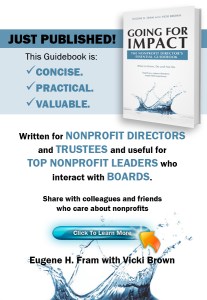
Going For Impact–The Nonprofit Director’s Essential Guidebook: What to Know, Do and Not Do based on a veteran director’s ample field experience

Helps board members to lead wisely, effectively and efficiently.

approved_Fram_Guidebook-emailer

Save

Save

Onboarding the New Nonprofit CEO: Who’s In Charge?

Onboarding the New Nonprofit CEO: Who’s In Charge?id-100423604

By Eugene Fram                  Free Digital image

When the chair of the search committee announces that a new CEO has been selected, there is visible relief in the boardroom. After the stress of a waning—or even absent executive at the helm, directors tend to relax, engaging in a series of social events that provide a pleasant if superficial acquaintance with the new executive.

What actually lies ahead is much more serious and vital to the future of the organization. Call it orientation, acculturation or transitioning; it is the board’s responsibility to see that the CEO is grounded in every aspect of the organization. And that requires a plan that is carefully structured and may take a year to complete. Major responsibility for the plan and its implementation rests with the board chair and one or more senior board members. While there are may formats to achieve this goal, the best, in my opinion, is what has been described as a customized format.

Under a customized format the nonprofit board tailors a program that helps the new executive develop a solid base in the organization and an understanding of its unique climate and culture.
Biweekly meetings should be scheduled. However, both sides should be wary if the time required does not decrease considerably as the year progresses. The CEO will then operate more independently, perhaps even making modest mistakes from which he/s can easily recover. Those handling the orientation must take care to delegate responsibility incrementally, based on the CEO’s background and experiences. Every custom designed orientation program should include nine steps. Some must be taken in sequence, while other steps can proceed concurrently. (more…)

Mismanagement Causes Huge Agency Failure—A Word To The Wise Nonprofit?

Mismanagement Causes Huge Agency Failure—A Word To The Wise Nonprofit?

By Eugene Fram

Rarely do failed for-profit or nonprofit organizations get a posthumous review of what actually went wrong. The collapse of one of the largest nonprofits in the US, the Federal Employment Guidance Service (FEGS) of New York City, is a noteworthy exception. Details of the causes that led to the human service’s demise were aired widely throughout NY media. * This organization had a $250 million budget, with 1900 employees who served 120,000 households covering a range of mental health and disability services, housing, home care and employment services.

Following are my interpretations of what its board should have done to avoid such a tragedy. (more…)

Who is Primarily Accountable for Long Term Planning – Board or CEO?

Who is Primarily Accountable for Long Term Planning – Board or CEO?

By: Eugene Fram

THE QUESTION

Can you further clarify whom you see as accountable for making what decisions in relation to the various aspects of corporate strategy creation and execution? If the board approves the CEO’s decisions do they not become board decisions? Where is the scope for the CEO to be accountable for making his or her own decisions?

MY ANSWER
“(My model)… promotes accountability. It requires the board and the CEO to work together to paint the big picture for the organization. It then holds the CEO accountable for implementing that vision. The (board’s) planning and resource committee (also) plays a major part in painting this picture by helping the organization and the CEO to look ahead to look to the future.”

Now for some details also found in “Policy vs. Paper Clips. * (http://amzn.to/eu7nQl) (more…)

Dysfunctional Levels in Nonprofit Boards & Organizations.

Dysfunctional Levels in Nonprofit Boards & Organizations.

By: Eugene Fram

Viewer favorite updated and revised. (/Strong)

Article and studies from a Google search on “Dysfunctions in Nonprofit Boards & Organizations,” yields 543.000 items in .46 of a second. These items show dysfunctions on charter school boards, church boards, healthcare boards, trade associations, etc.

Rick Moyers, a well-known nonprofit commentator and nonprofit researcher, concluded:

“A decade’s worth of research suggests that board performance is at best uneven and at worst highly dysfunctional. ….. The experiences of serving on a board — unless it is high functioning, superbly led, supported by a skilled staff and working in a true partnership with the executive – is quite the opposite of engaging.”

These data and comments can lead one to conclude that all nonprofit boards are dysfunctional. I suggest that nonprofit boards can generate a range of dysfunctional behavioral outcomes, but the staff can muddle through and continue to adequately serve clients. (more…)

21st Century Nonprofit Boards Need to be Pro-Active in Strategy Development

21st Century Nonprofit Boards Need to be Pro-Active in Strategy Development

By: Eugene Fram

Most Boards do not excel at strategy planning. In fact, when the subject is included on a meeting agenda, it usually produces a general lack of enthusiasm. A recent McKinsey study * cited weakness in for-profit boards dealing with the topic. And in my opinion, similar deficits are endemic to nonprofit boards whose response to strategic proposals is often simply– “ to review and approve.”

What causes these vital governing bodies to be passive when the future of the organization is obviously at stake? First, most nonprofit boards meet between 8 and 12 times a year, for what averages to about 1.5 hours monthly. With an agenda crammed with compliance issues and staff reports, there is little time left for board members to dive deeply into a discussion of future transformative efforts on behalf of the organization. When a new strategic plan is developed (that may only occur once every 3-5 years), its implementation is not as rigorous as it should be—even in high performing boards. (more…)