Trustee Boards

Do Business and Nonprofit Boards Have Common MOs?

Do Business and Nonprofit Boards Have Common MOs?

By: Eugene Fram

My blog posts in the past have frequently suggested that nonprofit boards can successfully adapt common practices used by for-profit boards. Gail McGovern, former senior business executive, now CEO of the American Red Cross posits that both types of boards innately borrow from each other’s operating traditions. * Following are my reactions to the major issues she raises: (more…)

Big Data Are Great—But Imperfect Metrics Work for Nonprofit Boards!

Big Data Are Great—But Imperfect Metrics Work for Nonprofit Boards!

By Eugene Fram

Nonprofit boards need to expand their evaluations of nonprofit managers and their organizations adding more behavioral impacts * to their evaluations.
For example it might be the number of volunteers that have been trained by the organizations. But boards must go to the next level in the 21st century.
In the case of volunteers, they must seek to understand the impacts on those trained. They need, for instance, to understand how well these volunteers are assisting clients and how they are representing the nonprofit to the clients. The training is a process, but their relationships with clients are impacts.

Qualitative data must be developed to the next level, and the average nonprofit CEO will argue that he/she doesn’t have the staff or expertise to develop impact data. Engaging an outside organization to complete a simple project can cost thousands of dollars. (more…)

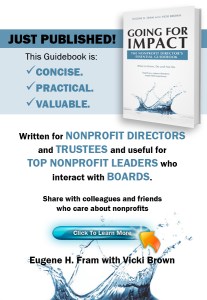
Going For Impact–The Nonprofit Director’s Essential Guidebook: What to Know, Do and Not Do based on a veteran director’s ample field experience

Helps board members to lead wisely, effectively and efficiently.

approved_Fram_Guidebook-emailer

Save

Save

Onboarding the New Nonprofit CEO: Who’s In Charge?

Onboarding the New Nonprofit CEO: Who’s In Charge?id-100423604

By Eugene Fram                  Free Digital image

When the chair of the search committee announces that a new CEO has been selected, there is visible relief in the boardroom. After the stress of a waning—or even absent executive at the helm, directors tend to relax, engaging in a series of social events that provide a pleasant if superficial acquaintance with the new executive.

What actually lies ahead is much more serious and vital to the future of the organization. Call it orientation, acculturation or transitioning; it is the board’s responsibility to see that the CEO is grounded in every aspect of the organization. And that requires a plan that is carefully structured and may take a year to complete. Major responsibility for the plan and its implementation rests with the board chair and one or more senior board members. While there are may formats to achieve this goal, the best, in my opinion, is what has been described as a customized format.

Under a customized format the nonprofit board tailors a program that helps the new executive develop a solid base in the organization and an understanding of its unique climate and culture.
Biweekly meetings should be scheduled. However, both sides should be wary if the time required does not decrease considerably as the year progresses. The CEO will then operate more independently, perhaps even making modest mistakes from which he/s can easily recover. Those handling the orientation must take care to delegate responsibility incrementally, based on the CEO’s background and experiences. Every custom designed orientation program should include nine steps. Some must be taken in sequence, while other steps can proceed concurrently. (more…)

Mismanagement Causes Huge Agency Failure—A Word To The Wise Nonprofit?

Mismanagement Causes Huge Agency Failure—A Word To The Wise Nonprofit?

By Eugene Fram

Rarely do failed for-profit or nonprofit organizations get a posthumous review of what actually went wrong. The collapse of one of the largest nonprofits in the US, the Federal Employment Guidance Service (FEGS) of New York City, is a noteworthy exception. Details of the causes that led to the human service’s demise were aired widely throughout NY media. * This organization had a $250 million budget, with 1900 employees who served 120,000 households covering a range of mental health and disability services, housing, home care and employment services.

Following are my interpretations of what its board should have done to avoid such a tragedy. (more…)

Nonprofit Board Members Have The Potential To Become Great Ambassadors!

Nonprofit Board Members Have The Potential To Become Great Ambassadors!

By: Eugene Fram

There is no shortage of able communicators on most nonprofit boards. Directors usually bring a degree of passion, purpose and special abilities to their term of service. Many come from business or professional environments that require at least a measure of experience in advocacy, often referred to as “selling” an idea or product!

But rarely do Board Chairs and CEOs avail themselves of the opportunity to develop nonprofit directors as fully functioning ambassadors for the organization. With a constantly rotating board and emerging crises, it becomes difficult to find the time and energy to coach board members in the art of putting the organization’s public face on view. In some cases the CEO simply doesn’t encourage contact between the board and staff. At other times, they fail to include selected directors in important conversations with key public figures and/or major donors or foundation executives. Such omissions represent a major talent loss in the advocacy process. (more…)

Who is Primarily Accountable for Long Term Planning – Board or CEO?

Who is Primarily Accountable for Long Term Planning – Board or CEO?

By: Eugene Fram

THE QUESTION

Can you further clarify whom you see as accountable for making what decisions in relation to the various aspects of corporate strategy creation and execution? If the board approves the CEO’s decisions do they not become board decisions? Where is the scope for the CEO to be accountable for making his or her own decisions?

MY ANSWER
“(My model)… promotes accountability. It requires the board and the CEO to work together to paint the big picture for the organization. It then holds the CEO accountable for implementing that vision. The (board’s) planning and resource committee (also) plays a major part in painting this picture by helping the organization and the CEO to look ahead to look to the future.”

Now for some details also found in “Policy vs. Paper Clips. * (http://amzn.to/eu7nQl) (more…)

Dysfunctional Levels in Nonprofit Boards & Organizations.

Dysfunctional Levels in Nonprofit Boards & Organizations.

By: Eugene Fram

Viewer favorite updated and revised. (/Strong)

Article and studies from a Google search on “Dysfunctions in Nonprofit Boards & Organizations,” yields 543.000 items in .46 of a second. These items show dysfunctions on charter school boards, church boards, healthcare boards, trade associations, etc.

Rick Moyers, a well-known nonprofit commentator and nonprofit researcher, concluded:

“A decade’s worth of research suggests that board performance is at best uneven and at worst highly dysfunctional. ….. The experiences of serving on a board — unless it is high functioning, superbly led, supported by a skilled staff and working in a true partnership with the executive – is quite the opposite of engaging.”

These data and comments can lead one to conclude that all nonprofit boards are dysfunctional. I suggest that nonprofit boards can generate a range of dysfunctional behavioral outcomes, but the staff can muddle through and continue to adequately serve clients. (more…)

21st Century Nonprofit Boards Need to be Pro-Active in Strategy Development

21st Century Nonprofit Boards Need to be Pro-Active in Strategy Development

By: Eugene Fram

Most Boards do not excel at strategy planning. In fact, when the subject is included on a meeting agenda, it usually produces a general lack of enthusiasm. A recent McKinsey study * cited weakness in for-profit boards dealing with the topic. And in my opinion, similar deficits are endemic to nonprofit boards whose response to strategic proposals is often simply– “ to review and approve.”

What causes these vital governing bodies to be passive when the future of the organization is obviously at stake? First, most nonprofit boards meet between 8 and 12 times a year, for what averages to about 1.5 hours monthly. With an agenda crammed with compliance issues and staff reports, there is little time left for board members to dive deeply into a discussion of future transformative efforts on behalf of the organization. When a new strategic plan is developed (that may only occur once every 3-5 years), its implementation is not as rigorous as it should be—even in high performing boards. (more…)

Nonprofit Boardroom Elephants and the ‘Nice Guy’ Syndrome: A Complex Problem

Nonprofit Boardroom Elephants and the ‘Nice Guy’ Syndrome: A Complex Problem

By: Eugene Fram

An updated and revised viewer favorite post

At coffee a friend serving on a nonprofit board reported plans to resign from the board shortly. His complaints centered on the board’s unwillingness to take critical actions necessary to help the organization grow.

In specific, the board failed to take any action to remove a director who wasn’t attending meetings, but he refused to resign. His term had another year to go, and the board had a bylaws obligation to summarily remove him from the board. However, a majority of directors decided such action would hurt the director’s feelings. They were unwittingly accepting the “nice-guy” approach in place of taking professional action.

In another instance the board refused to sue a local contractor who did not perform as agreed. The “elephant” was that the board didn’t think that legally challenging a local person was appropriate, an issue raised by an influential director. However, nobody informed the group that in being “nice guys,” they could become legally liable, if somebody became injured as a result of their inaction.

Over the years, I have observed many boards with elephants around that have caused significant problems to a nonprofit organization. Some include: (more…)