volunteers

Should Nonprofit Boards Be A Boot Camp for Corporate Executives?

id-100264513

Should Nonprofit Boards Be A Boot Camp for Corporate Executives?

By: Eugene Fram                  Free Digital Photo

Alice Korngold, President of Korngold Consulting, suggests, “Nonprofit board service is the ultimate leadership opportunity, giving business executives the personal and professional skills they need… .“ * She suggests that the following abilities can be developed from such experiences. But the neophyte  director can become attuned to some inappropriate nonprofit practices and promote them on subsequent nonprofit board assignments.  (more…)

Nonprofits in Limbo: Preparing for the Unexpected

id-100463945                                                                                                                                                                                                                          Free Digital Photo

Nonprofits in Limbo: Preparing for the Unexpected

By: Eugene Fram

As the nation is reeling from the jolt of the 2016 election results, I happened to read a recent report from Deliotte Consulting suggesting ways that for-profit organizations can improve their performance in uncertain times. The report centers on key drivers of board effectiveness that, in my opinion, resonate with similar nonprofit situations. Most nonprofit boards typically live with uncertainty and are perennially “on the edge.” Here are some ideas from the Deloitte * report that, when adapted early, can bolster their operation in times of disruption.

  • Bold, decisive leadership: Nonprofit boards are responsible for donor and charitable types of revenues that place directors in a public trust position. In addition board members typically will only be active for a median tenure period of four to six years. As a result they often become overly conservative in their strategic views and may accept CEOs that “mind-the-store” with modest incremental growth annually.

To prevent the organizational boat from capsizing in the perpetual seas of uncertain times, the board needs rely on  the best forward looking information about strategy, culture, people and clients. All of this must be in solid  alignment with a substantial mission, or a modified one if the external environment requires it. This allows the  nonprofit to cut through the cultural barriers that impede strategy development. As Peter Drucker has noted, “Culture eats strategy for breakfast every morning.”

  • Opportunity mind-set: Even when the organization is prospering, the board has a responsibility to press for innovations and to support small-scale experiments as called for in a “Lean Management” structure. Within this structure, the staff can test the waters via experiments to move more boldly, as long as the experiments yield positive results. **
  • Stakeholders: Nonprofits have a multitude of stakeholders, complicated by the fact that often those who receive the service are not the ones who support or pay for it.   This requires management to balance the needs of the various groups and that can call for heart-breaking decisions. For example, should revenues be allocated to marketing or used for needed client programs? To solve the dilemmas Deliotte suggests, “Building valuable, open relationships across multiple stakeholder groups is key to building trust and organizational resilience”
  • Match fit: Boards have a responsibility to motivate the nonprofit to realistically evaluate the tensions between new models and existing ones. Two examples show contrasting results. Easter Seals boards perceived the market changes involved with polio vaccines and modified their missions.   Nonprofit counseling agencies failed to assess the positive impacts of new pharmaceuticals and the need for face-to face counseling declined. To develop a fit, Deliotte suggests, “the board and the organization need to be agile and open.”
  • Culture, culture, and culture: Nonprofit boards’ cultures play a key role in determining the level of risk the board is willing to take. With key drivers, nonprofit boards have to take reasonable risks to survive and even encourage management to take it. Small scale, yet bold, experimentations that are jointly reviewed by board and management provide a “Lean Management” approach that has been used by venture supported business firms.
  • Cracking the diversity Code: Instead of recruiting new board members and maximizing the best they have to offer, nonprofit boards try to orient new board members to the current culture. A new member with a financial planning background, for example, will be asked to work with the CFO on accounting related problems. Instead, he/s should be asked to develop a long term-term financial plan.   Board background (such as strategic planning abilities, critical thinking) diversity, as well as demographic (such as gender, ethnicity) ones, must be carefully crafted and utilized as well as demographics.
  • Curiosity is Key: Deliotte Consulting concludes, “Directors should get out of the ‘same old’ board room, and should even look across borders to learn from approaches in (different nonprofits) and companies… . Developing news skills and insights are essential for innovation and should be sought to create the questioning and challenging environment needed to imagine, inspire and deliver better outcomes (and impacts). Complacency (in uncertain times) can be a killer.”

*https://www.google.com/search?q=Sevn+ways+to+im%5Bprove+board+effectivness+in+uncertgain+times&ie=utf-8&oe=utf-8#q=Seven+ways+to+improve+board+effectiveness+in+uncertain+times

**https://www.snpo.org/publications/sendpdf.php?id=2014


Save

Save

Save

Save

Save

Save

Save

Once Again: Who Should Be Involved in Fund Development and How?

id-100213583

Once Again: Who Should Be Involved in Fund Development and How?

Updated & Revised

By Eugene Fram                            Free Digital Photo

This is a perennial issue. Following are suggestions that can clarify questions related  to it. (more…)

Nonprofit Board Recruitment Process Calls For New Approach

id-10066412Free Digital Photo

Nonprofit Board Recruitment Process Calls For New Approach

By: Eugene Fram

One thing is certain about nonprofit director turnover is a board completely turns over about every four to six years. * With that fact in mind, both board and management need to act as interim “talent scouts” for potential directors who will be competent to tackle the sometimes unpredictable challenges of the future. Just as unexpected crises will confound the new president elect and his colleagues, those who occupy the nonprofit boardroom must be well equipped to deal with the inevitable issues that are certain to arise.  ** (more…)

Board and executive director trust issues? Look at these problem areas

gfi2

  • Each party may occasionally step on the other’s toes
  • Over aggressive directors can go too far
  • There must be a fair but robust CEO evaluation process
  • Does the board provide growth opportunities for the CEO?

Click link for insights:    goo.gl/akvlE7


Save

Save

Save

Getting The Most From Your Nonprofit Board

id-10045240

From: Tony Martignetti–Nonprofit Radio     Free Digital Photo

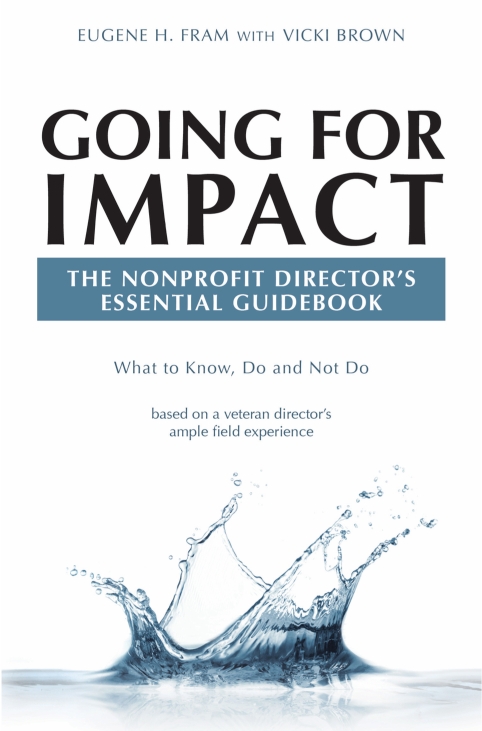
Thanks to today’s guest 10/28/2016, Eugene Fram, professor emeritus at @Rochester Institute of Technology, and author of “Going For Impact: The Nonprofit Director’s Essential Guidebook.” Let’s takeaway!

  • strive for excellence; your board & CEO should avoid mediocrity
  • avoid excess deference to CEO, board chair & major donor board members
  • be explicit about board members’ responsibilities & expectations, don’t turn it into into legalese
  • bad news must rise to management & the board
  • have a vibrant recruiting process, don’t dumb it down
  • your board’s most important job is hiring and overviewing the CEO and developing robust assessment processes
  • develop high levels of trust between Board-Management-Staff
  • understand the big differences between outcome and impact.
  • so much more, listen!

http://podcast.mpgadv.com/2016/10/313-get-the-most-from-your-board-tony-martignetti-nonprofit-radio/


Save

Save

Save

A Special Relationship: Nurturing the CEO-Board Chair Bond*

id-100121468

A Special Relationship: Nurturing the CEO-Board Chair Bond

By Eugene Fram              Free Digital Photo

Viewer Favorite – Updated & Revised

Here are tips to assure the best possible partnership between the board chair and CEO.

Keeping boards focused on strategic issues is a major challenge for nonprofit leaders.  This leadership crisis is intensified by the fact that board chairs tend to have short terms (according to BoardSource, 83% stay in office only one or two years). Thus, nonprofit CEOs  and board chairs need to bond quickly. For the good of the organization, they must come together swiftly and create a partnership that works. Here are golden rules for the CEO and board chair to follow: (more…)

Better Board Governance. Is it the same for both business & nonprofit organizations?

id-100323428id-100120975

Better Board Governance. Is it the same for both business & nonprofit organizations?

By: Eugene Fram                  Free Digital Photo

Viewer Favorite: Updated & Enhanced

Both BoardSource in 2015 and the Charted Global Management Accountant (CGMA) in 2012 have issued reports on improving board governance. The former group focuses on nonprofit boards and the latter focuses on business boards globally.* Both the nonprofit and business organization reports listed the following prime areas for board improvement or focus: The CGMA report called for improved strategy development & risk analysis; better boardroom behaviors; better relationships between board & management. The BoardSource report asked for improved focus on strategy, with much less emphasis on operations; more board commitment, engagement, & attendance; better self-assessment, recruitment & development.

Although the CGMA report does not differentiate the types (strategic vs. operational strategy) the “risk oversight” notation can indicate there is a need for greater board focus on long-term strategy. For nonprofit boards, the strategic side of planning is often neglected. There has been a decades-long board culture support for directors’ involvement in operational decisions, often leading to board micromanagement and less strategic interest.

(more…)

Establish a board culture that limits micromanagement

id-100261897

FREE DIGITAL  PHOTO

Nonprofits need substantial trust between board members and management.  If all board members and the CEO understand the board mandated boundary line for governance versus operations decision-making, both sides will recognize their responsibilities with limited board micromanagement.  This is not to say that each may overstep the boundary line on rare occasions, but infractions must be approached professionally with partnership civility.

http://www.boardandadministrator.com/Article-Detail/establish-a-board-culture-that-limits-micromanagement.aspx

Common Practices Nonprofit Boards Need To Avoid

id-100260980

Common Practices Nonprofit Boards Need To Avoid

By: Eugene Fram         Free Digital  Photo

Viewer Favorite:  Revised and Updated

Peter Rinn, Breakthrough Solutions Group,* published a list of weak nonprofit board practices. Following are some of the items listed and my estimation of what can be done about them, based on my experiences as a nonprofit board director, board chair and consultant.

Dumbing down board recruitment.Trumpeting the benefits and not stressing the responsibilities of board membership.
Board position offers frequently may be accepted without the candidate doing sufficient due diligence. At the least, the candidate should have a personal meeting with the executive director and board chair. Issues that need to be clarified are meeting schedules, “give/get” policies and time expectations. In addition, the candidate, if seriously interested, should ask for copies of the board meeting minutes for one year, the latest financials, and the latest IRS form 990.

(more…)