- Each party may occasionally step on the other’s toes
- Over aggressive directors can go too far
- There must be a fair but robust CEO evaluation process
- Does the board provide growth opportunities for the CEO?
Click link for insights: goo.gl/akvlE7
Click link for insights: goo.gl/akvlE7

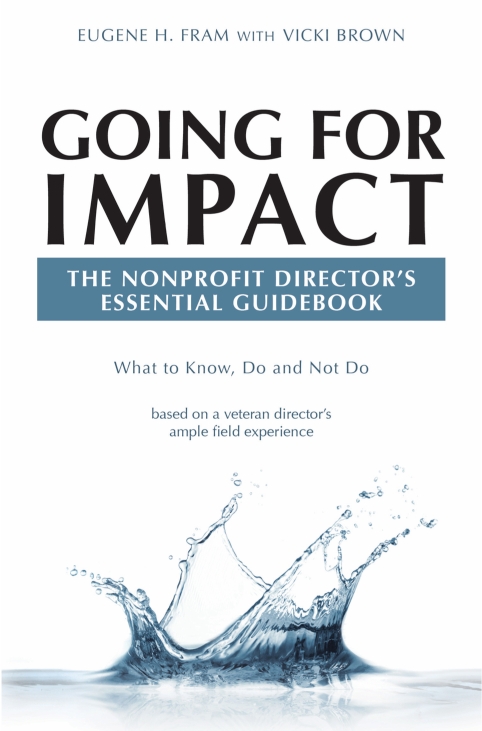
Thanks to today’s guest 10/28/2016, Eugene Fram, professor emeritus at @Rochester Institute of Technology, and author of “Going For Impact: The Nonprofit Director’s Essential Guidebook.” Let’s takeaway!
http://podcast.mpgadv.com/2016/10/313-get-the-most-from-your-board-tony-martignetti-nonprofit-radio/

By: Eugene Fram Free Digital Photo
Viewer Favorite: Revised and Updated
Peter Rinn, Breakthrough Solutions Group,* published a list of weak nonprofit board practices. Following are some of the items listed and my estimation of what can be done about them, based on my experiences as a nonprofit board director, board chair and consultant.
• Dumbing down board recruitment.Trumpeting the benefits and not stressing the responsibilities of board membership.
Board position offers frequently may be accepted without the candidate doing sufficient due diligence. At the least, the candidate should have a personal meeting with the executive director and board chair. Issues that need to be clarified are meeting schedules, “give/get” policies and time expectations. In addition, the candidate, if seriously interested, should ask for copies of the board meeting minutes for one year, the latest financials, and the latest IRS form 990.

Pressure Test Your Nonprofit’s Fund Development Efforts
By: Eugene Fram
It’s no secret that nonprofits do not excel in the craft of fundraising. A 2015 study reported that 65% of CEOs gave their boards academic grades of “C” or below for efficacy on this front. Yet most will agree that without the continuous influx of financial support, the mission to which the directors have committed themselves will fail!
I clearly remember examples of this deficit from my own board experience—one in which I served on the fund development committee for a small nonprofit which met monthly for about a year. A sincere and hardworking board chair headed it, but the meetings took place without the presence of the CEO. Many ideas with merit were exchanged such as developing a reserve fund, “get or give” board requirements etc. There was a lot of talk but no implementation, and after a year of pure discussion, a new president, who convened a new committee, disbanded the group.
A review of the pressure points in key fundraising activities would have taken the group from talk to action and further implementation. Here are three activities and their variations that I consider most critical to nonprofit development processes:
(more…)
Improve Your Nonprofit Director Onboarding Process using Going For Impact
New guidebook covers
What to Know, Do and Not Do
As a veteran director with extensive experience on 12 nonprofit boards I have been “treated” to a wide variety of on-boarding sessions for new directors.
They’ve ranged from asking:
Going For Impact: The Nonprofit Director’s Essential Guidebook lets you improve such sessions by making on-boarding governance material more meaningful and interesting. For example:
Going for Impact can also be utilized by creative boards and CEOs to develop retreat agendas that can help enhance their board’s governance perspectives!
“Going for Impact” ©2016 https://goo.gl/Dwa9le
Establishing Effective Nonprofit Board Committees – What to Do.
By Eugene Fram
Updated & Revised.
Following are ways that many nonprofit boards have established effective board committees using my governance model as described in the third edition of Policy vs. Paper Clips.
• In the planning effort, focus board personnel and financial resources only on those topics that are germane to the organization at a particular time. For example, financial planning, long-range planning or short-range planning. However the board needs to be open to generative planning if new opportunities present themselves or are developed via board leadership. (more…)
Identify Nonprofit Staff Groups To Help Drive Organizational Change
By Eugene Fram
Nonprofit executive directors tend to think of the staff professionals as individual contributors. These individuals are persons who mainly work on their own and not as team players – for instance, counselors, health care professionals, curators and university faculty. However, many executive directors fail to recognize that these individual contributors can be grouped according to identifiable types, with differing work value outlooks. Each group needs to be managed differently to drive change in today’s fast moving social, political and technological environments. Nonprofit board members need to use these groupings in their responsibilities for overseeing promotable staff members. (more…)
What are the most productive types of relationships between board & staff?
By: Eugene Fram
In the 21st century, building transparency and trust are two critical elements for good governance. In nonprofit organizations, these elements take on additional importance because organizationally staff members may only be or two levels below the board. Consequently, nonprofit staffs are probably more attuned to board changes and directives than their counterparts in a business setting. With more frequent rotations of nonprofit board members, many staff members can feel insecure. They have observed some nonprofits at which new board members sometimes can quickly bring about detrimental changes–it is not unusual for community boards to limit vetting new board members to friends and family. (more…)
Can A Nonprofit Organization Have A President/CEO & An Executive Director?
By: Eugene H. Fram
Viewer Favorite Revised & Updated
Yes, if the organization has the following structure:
Board With A Volunteer Chairperson
President/CEO With Full Authority for Operations
Executive Director for Division A
Executive Director for Division B
However this structure can be confusing to persons in the nonprofit arena. The executive director should have final authority for all operational matters related to the organization, except those designated for the board in the bylaws. For example, pensions plan changes.
The big question is who carries the CEO title. Some nonprofits, in their early stages, have a volunteer, part-time, President/CEO and an operational Executive Director. This signifies the volunteer, representing the will of the board, can have final authority in all daily and policy issues. This is not a good structure because the CEO title might lead to the volunteer having liabilities that other board members don’t have. (more…)
Big Data Are Great—But Imperfect Metrics Work for Nonprofit Boards!
By Eugene Fram
Nonprofit boards need to expand their evaluations of nonprofit managers and their organizations adding more behavioral impacts * to their evaluations.
For example it might be the number of volunteers that have been trained by the organizations. But boards must go to the next level in the 21st century.
In the case of volunteers, they must seek to understand the impacts on those trained. They need, for instance, to understand how well these volunteers are assisting clients and how they are representing the nonprofit to the clients. The training is a process, but their relationships with clients are impacts.
Qualitative data must be developed to the next level, and the average nonprofit CEO will argue that he/she doesn’t have the staff or expertise to develop impact data. Engaging an outside organization to complete a simple project can cost thousands of dollars. (more…)
 Nonprofit Management