
Once Again: Who Should Be Involved in Fund Development and How?
Updated & Revised
By Eugene Fram Free Digital Photo
This is a perennial issue. Following are suggestions that can clarify questions related to it. (more…)
Once Again: Who Should Be Involved in Fund Development and How?
Updated & Revised
By Eugene Fram Free Digital Photo
This is a perennial issue. Following are suggestions that can clarify questions related to it. (more…)

Once Again! Do Nonprofit Directors Face Cyber Security Risks?
By: Eugene Fram Free Digital Photo
Viewer Favorite: Updated & Expanded
The cyber security (CS) debacles faced by Target, Sony Pictures and others may seem far afield from the concerns of nonprofit directors, except for the giants in the area, like AARP. However, think about this hypothetical scenario.
A group of high school students hacked into the computer system of a local nonprofit offering mental health services and gain access to records of clients, perhaps even placing some of the records of other teenagers on the internet.
What due care obligations did the board need to forestall the above situation? A move to recruit directors with special expertise in information technology or cyber security would be nonproductive. A nonprofit director has broader responsibilities such as the overview of management, approval of budgets, fostering management and staff growth etc. Similarly, when social media became a prominent issue a few years ago, boards debated the advisability of seeking directors with that specific kind of background. Today, a consultant with management experience in the area is likely needed to provide guidance to directors on these social media issues.
Click link for insights: goo.gl/akvlE7

Thanks to today’s guest 10/28/2016, Eugene Fram, professor emeritus at @Rochester Institute of Technology, and author of “Going For Impact: The Nonprofit Director’s Essential Guidebook.” Let’s takeaway!
http://podcast.mpgadv.com/2016/10/313-get-the-most-from-your-board-tony-martignetti-nonprofit-radio/

FREE DIGITAL PHOTO
Nonprofits need substantial trust between board members and management. If all board members and the CEO understand the board mandated boundary line for governance versus operations decision-making, both sides will recognize their responsibilities with limited board micromanagement. This is not to say that each may overstep the boundary line on rare occasions, but infractions must be approached professionally with partnership civility.

By: Eugene Fram Free Digital Photo
Viewer Favorite: Revised and Updated
Peter Rinn, Breakthrough Solutions Group,* published a list of weak nonprofit board practices. Following are some of the items listed and my estimation of what can be done about them, based on my experiences as a nonprofit board director, board chair and consultant.
• Dumbing down board recruitment.Trumpeting the benefits and not stressing the responsibilities of board membership.
Board position offers frequently may be accepted without the candidate doing sufficient due diligence. At the least, the candidate should have a personal meeting with the executive director and board chair. Issues that need to be clarified are meeting schedules, “give/get” policies and time expectations. In addition, the candidate, if seriously interested, should ask for copies of the board meeting minutes for one year, the latest financials, and the latest IRS form 990.
How Do Nonprofit Leaders Manage Unsolicited “Great Ideas?”
By: Eugene Fram Free Digital Photo
What does a board member or CEO do when a donor or valued volunteer approaches him/h with a great idea that needs to be implemented at once? Since most of these ideas are what a Stanford professor terms bad ideas, the board chair and CEO are often between a hypothetical rock and a hard place! To agree to a proposed project that is impractical or irrelevant to the mission will put the nonprofit at risk. But to reject an eager volunteer or potential donor could have serious donor related financial or interpersonal consequences.
When bad ideas are suggested, nonprofit directors and CEOs traditionally have hastily reviewed them—then prolonged the evaluation process hoping the presenter will lose interest in it. When an immediate reply is called for, a full review of the project will involve board and management time and effort to provide a fair assessment. If the verdict is negative, everyone hopes for the best!

Pressure Test Your Nonprofit’s Fund Development Efforts
By: Eugene Fram
It’s no secret that nonprofits do not excel in the craft of fundraising. A 2015 study reported that 65% of CEOs gave their boards academic grades of “C” or below for efficacy on this front. Yet most will agree that without the continuous influx of financial support, the mission to which the directors have committed themselves will fail!
I clearly remember examples of this deficit from my own board experience—one in which I served on the fund development committee for a small nonprofit which met monthly for about a year. A sincere and hardworking board chair headed it, but the meetings took place without the presence of the CEO. Many ideas with merit were exchanged such as developing a reserve fund, “get or give” board requirements etc. There was a lot of talk but no implementation, and after a year of pure discussion, a new president, who convened a new committee, disbanded the group.
A review of the pressure points in key fundraising activities would have taken the group from talk to action and further implementation. Here are three activities and their variations that I consider most critical to nonprofit development processes:
(more…)
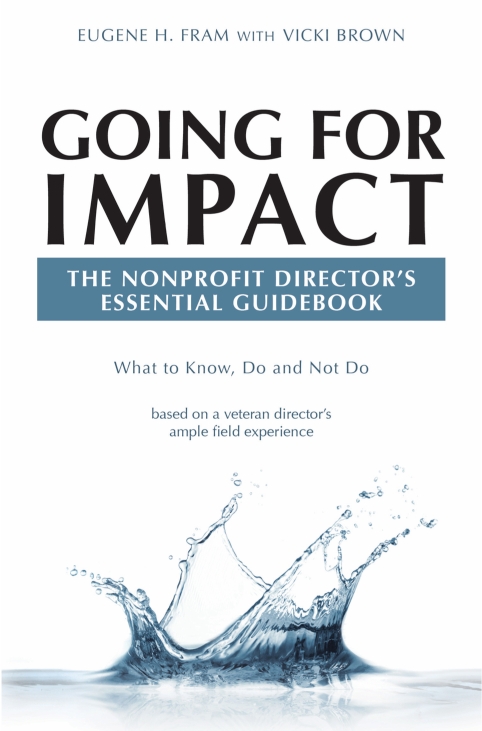
Improve Your Nonprofit Director Onboarding Process using Going For Impact
New guidebook covers
What to Know, Do and Not Do
As a veteran director with extensive experience on 12 nonprofit boards I have been “treated” to a wide variety of on-boarding sessions for new directors.
They’ve ranged from asking:
Going For Impact: The Nonprofit Director’s Essential Guidebook lets you improve such sessions by making on-boarding governance material more meaningful and interesting. For example:
Going for Impact can also be utilized by creative boards and CEOs to develop retreat agendas that can help enhance their board’s governance perspectives!
“Going for Impact” ©2016 https://goo.gl/Dwa9le
Nonprofit Board And Internal Working Environments—No Pieces of Cake!
By: Eugene Fram
People who work in the business community sometimes view nonprofit organizations as “cushy” places to work. The truth is that today’s nonprofits have challenges that are very different from those of the corporate world–and typically struggle to accommodate parameters such as restricted finances, increasing wage costs that must aligned with ever expanding client needs. In addition, board members must be concerned about personal liabilities under special legislations such as completing the IRS Form 990 and The Intermediate Sanctions Act. * Not easy!
A recent article in the Wall Street Journal discusses the hypothetical release from “grind” pressures a business executive might experience when moving employment to a nonprofit. ** Following are some of the specific advantages cited by the article (in bold) followed, by some of my real world observations.

