- Each party may occasionally step on the other’s toes
- Over aggressive directors can go too far
- There must be a fair but robust CEO evaluation process
- Does the board provide growth opportunities for the CEO?
Click link for insights: goo.gl/akvlE7
Click link for insights: goo.gl/akvlE7

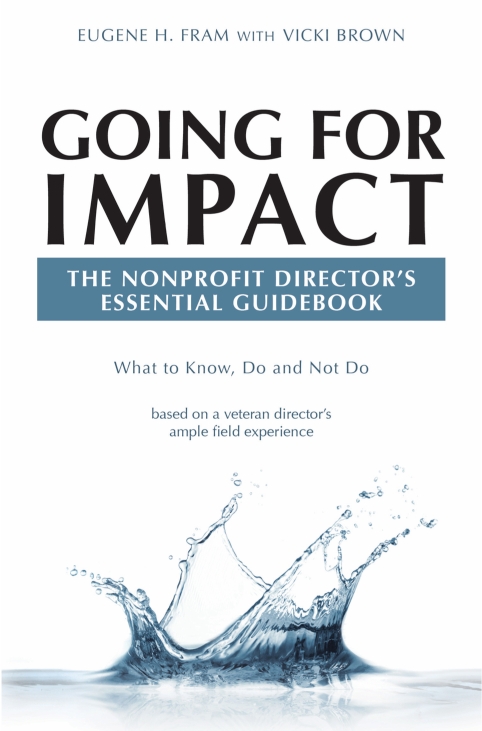
Thanks to today’s guest 10/28/2016, Eugene Fram, professor emeritus at @Rochester Institute of Technology, and author of “Going For Impact: The Nonprofit Director’s Essential Guidebook.” Let’s takeaway!
http://podcast.mpgadv.com/2016/10/313-get-the-most-from-your-board-tony-martignetti-nonprofit-radio/

A Special Relationship: Nurturing the CEO-Board Chair Bond
By Eugene Fram Free Digital Photo
Viewer Favorite – Updated & Revised
Here are tips to assure the best possible partnership between the board chair and CEO.
Keeping boards focused on strategic issues is a major challenge for nonprofit leaders. This leadership crisis is intensified by the fact that board chairs tend to have short terms (according to BoardSource, 83% stay in office only one or two years). Thus, nonprofit CEOs and board chairs need to bond quickly. For the good of the organization, they must come together swiftly and create a partnership that works. Here are golden rules for the CEO and board chair to follow: (more…)


Better Board Governance. Is it the same for both business & nonprofit organizations?
By: Eugene Fram Free Digital Photo
Viewer Favorite: Updated & Enhanced
Both BoardSource in 2015 and the Charted Global Management Accountant (CGMA) in 2012 have issued reports on improving board governance. The former group focuses on nonprofit boards and the latter focuses on business boards globally.* Both the nonprofit and business organization reports listed the following prime areas for board improvement or focus: The CGMA report called for improved strategy development & risk analysis; better boardroom behaviors; better relationships between board & management. The BoardSource report asked for improved focus on strategy, with much less emphasis on operations; more board commitment, engagement, & attendance; better self-assessment, recruitment & development.
Although the CGMA report does not differentiate the types (strategic vs. operational strategy) the “risk oversight” notation can indicate there is a need for greater board focus on long-term strategy. For nonprofit boards, the strategic side of planning is often neglected. There has been a decades-long board culture support for directors’ involvement in operational decisions, often leading to board micromanagement and less strategic interest.

FREE DIGITAL PHOTO
Nonprofits need substantial trust between board members and management. If all board members and the CEO understand the board mandated boundary line for governance versus operations decision-making, both sides will recognize their responsibilities with limited board micromanagement. This is not to say that each may overstep the boundary line on rare occasions, but infractions must be approached professionally with partnership civility.

By: Eugene Fram Free Digital Photo
Viewer Favorite: Revised and Updated
Peter Rinn, Breakthrough Solutions Group,* published a list of weak nonprofit board practices. Following are some of the items listed and my estimation of what can be done about them, based on my experiences as a nonprofit board director, board chair and consultant.
• Dumbing down board recruitment.Trumpeting the benefits and not stressing the responsibilities of board membership.
Board position offers frequently may be accepted without the candidate doing sufficient due diligence. At the least, the candidate should have a personal meeting with the executive director and board chair. Issues that need to be clarified are meeting schedules, “give/get” policies and time expectations. In addition, the candidate, if seriously interested, should ask for copies of the board meeting minutes for one year, the latest financials, and the latest IRS form 990.

How Do Nonprofit Boards Keep Stakeholders Engaged?
By: Eugene Fram Free Digital Photo
First, exactly who are the “stakeholders” in the nonprofit environment? Most directors would readily define the term as clients, staff and board members. But what about other participants such as external auditors and significant vendors? Surely a nonprofit that depends on a vendor to supply groceries can be hobbled if the food is not delivered properly. And, last but not least, the backbone of the organization — the volunteers! Many cogs in the wheel make the nonprofit world go around and need consistent and careful attention. Following are some guidelines for engaging all types of stakeholders:
How Do Nonprofit Leaders Manage Unsolicited “Great Ideas?”
By: Eugene Fram Free Digital Photo
What does a board member or CEO do when a donor or valued volunteer approaches him/h with a great idea that needs to be implemented at once? Since most of these ideas are what a Stanford professor terms bad ideas, the board chair and CEO are often between a hypothetical rock and a hard place! To agree to a proposed project that is impractical or irrelevant to the mission will put the nonprofit at risk. But to reject an eager volunteer or potential donor could have serious donor related financial or interpersonal consequences.
When bad ideas are suggested, nonprofit directors and CEOs traditionally have hastily reviewed them—then prolonged the evaluation process hoping the presenter will lose interest in it. When an immediate reply is called for, a full review of the project will involve board and management time and effort to provide a fair assessment. If the verdict is negative, everyone hopes for the best!
Improve Your Nonprofit Director Onboarding Process using Going For Impact
New guidebook covers
What to Know, Do and Not Do
As a veteran director with extensive experience on 12 nonprofit boards I have been “treated” to a wide variety of on-boarding sessions for new directors.
They’ve ranged from asking:
Going For Impact: The Nonprofit Director’s Essential Guidebook lets you improve such sessions by making on-boarding governance material more meaningful and interesting. For example:
Going for Impact can also be utilized by creative boards and CEOs to develop retreat agendas that can help enhance their board’s governance perspectives!
“Going for Impact” ©2016 https://goo.gl/Dwa9le
Corporate Governance Principles Make Sense to Nonprofits
A blue-ribbon group of public directors, people like Warren Buffett, has developed a nine page “manifesto” that presents commonsense operating principles for boards of publicly traded companies. Their objective is, “To provide a basic framework for sound, long-term oriented governance.” * My immediate response to the document was that about half of the guidelines can be easily translated into useful advice and/or caveats for nonprofit boards. The benefits as suggested by a Chinese proverb are, “A wise man learns from his own experiences, a wiser man learns from the experiences of others.”
 Nonprofit Management