Non profit outcomes

Nonprofits in Limbo: Preparing for the Unexpected

id-100463945                                                                                                                                                                                                                          Free Digital Photo

Nonprofits in Limbo: Preparing for the Unexpected

By: Eugene Fram

As the nation is reeling from the jolt of the 2016 election results, I happened to read a recent report from Deliotte Consulting suggesting ways that for-profit organizations can improve their performance in uncertain times. The report centers on key drivers of board effectiveness that, in my opinion, resonate with similar nonprofit situations. Most nonprofit boards typically live with uncertainty and are perennially “on the edge.” Here are some ideas from the Deloitte * report that, when adapted early, can bolster their operation in times of disruption.

  • Bold, decisive leadership: Nonprofit boards are responsible for donor and charitable types of revenues that place directors in a public trust position. In addition board members typically will only be active for a median tenure period of four to six years. As a result they often become overly conservative in their strategic views and may accept CEOs that “mind-the-store” with modest incremental growth annually.

To prevent the organizational boat from capsizing in the perpetual seas of uncertain times, the board needs rely on  the best forward looking information about strategy, culture, people and clients. All of this must be in solid  alignment with a substantial mission, or a modified one if the external environment requires it. This allows the  nonprofit to cut through the cultural barriers that impede strategy development. As Peter Drucker has noted, “Culture eats strategy for breakfast every morning.”

  • Opportunity mind-set: Even when the organization is prospering, the board has a responsibility to press for innovations and to support small-scale experiments as called for in a “Lean Management” structure. Within this structure, the staff can test the waters via experiments to move more boldly, as long as the experiments yield positive results. **
  • Stakeholders: Nonprofits have a multitude of stakeholders, complicated by the fact that often those who receive the service are not the ones who support or pay for it.   This requires management to balance the needs of the various groups and that can call for heart-breaking decisions. For example, should revenues be allocated to marketing or used for needed client programs? To solve the dilemmas Deliotte suggests, “Building valuable, open relationships across multiple stakeholder groups is key to building trust and organizational resilience”
  • Match fit: Boards have a responsibility to motivate the nonprofit to realistically evaluate the tensions between new models and existing ones. Two examples show contrasting results. Easter Seals boards perceived the market changes involved with polio vaccines and modified their missions.   Nonprofit counseling agencies failed to assess the positive impacts of new pharmaceuticals and the need for face-to face counseling declined. To develop a fit, Deliotte suggests, “the board and the organization need to be agile and open.”
  • Culture, culture, and culture: Nonprofit boards’ cultures play a key role in determining the level of risk the board is willing to take. With key drivers, nonprofit boards have to take reasonable risks to survive and even encourage management to take it. Small scale, yet bold, experimentations that are jointly reviewed by board and management provide a “Lean Management” approach that has been used by venture supported business firms.
  • Cracking the diversity Code: Instead of recruiting new board members and maximizing the best they have to offer, nonprofit boards try to orient new board members to the current culture. A new member with a financial planning background, for example, will be asked to work with the CFO on accounting related problems. Instead, he/s should be asked to develop a long term-term financial plan.   Board background (such as strategic planning abilities, critical thinking) diversity, as well as demographic (such as gender, ethnicity) ones, must be carefully crafted and utilized as well as demographics.
  • Curiosity is Key: Deliotte Consulting concludes, “Directors should get out of the ‘same old’ board room, and should even look across borders to learn from approaches in (different nonprofits) and companies… . Developing news skills and insights are essential for innovation and should be sought to create the questioning and challenging environment needed to imagine, inspire and deliver better outcomes (and impacts). Complacency (in uncertain times) can be a killer.”

*https://www.google.com/search?q=Sevn+ways+to+im%5Bprove+board+effectivness+in+uncertgain+times&ie=utf-8&oe=utf-8#q=Seven+ways+to+improve+board+effectiveness+in+uncertain+times

**https://www.snpo.org/publications/sendpdf.php?id=2014


Save

Save

Save

Save

Save

Save

Save

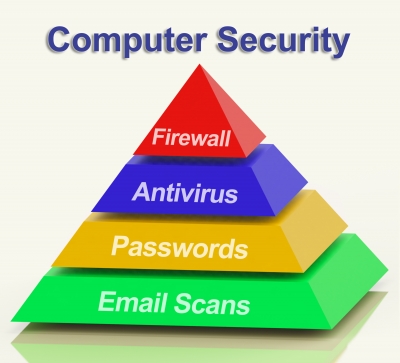
Once Again! Do Nonprofit Directors Face Cyber Security Risks?

id-10094966

Once Again! Do Nonprofit Directors Face Cyber Security Risks?

By: Eugene Fram     Free Digital Photo

Viewer Favorite: Updated & Expanded

The cyber security (CS) debacles faced by Target, Sony Pictures and others may seem far afield from the concerns of nonprofit directors, except for the giants in the area, like AARP. However, think about this hypothetical scenario.

A group of high school students hacked into the computer system of a local nonprofit offering mental health services and gain access to records of clients, perhaps even placing some of the records of other teenagers on the internet.

What due care obligations did the board need to forestall the above situation? A move to recruit directors with special expertise in information technology or cyber security would be nonproductive. A nonprofit director has broader responsibilities such as the overview of management, approval of budgets, fostering management and staff growth etc. Similarly, when social media became a prominent issue a few years ago, boards debated the advisability of seeking directors with that specific kind of background. Today, a consultant with management experience in the area is likely needed to provide guidance to directors on these social media issues.

(more…)

Nonprofit Board Recruitment Process Calls For New Approach

id-10066412Free Digital Photo

Nonprofit Board Recruitment Process Calls For New Approach

By: Eugene Fram

One thing is certain about nonprofit director turnover is a board completely turns over about every four to six years. * With that fact in mind, both board and management need to act as interim “talent scouts” for potential directors who will be competent to tackle the sometimes unpredictable challenges of the future. Just as unexpected crises will confound the new president elect and his colleagues, those who occupy the nonprofit boardroom must be well equipped to deal with the inevitable issues that are certain to arise.  ** (more…)

Board and executive director trust issues? Look at these problem areas

gfi2

  • Each party may occasionally step on the other’s toes
  • Over aggressive directors can go too far
  • There must be a fair but robust CEO evaluation process
  • Does the board provide growth opportunities for the CEO?

Click link for insights:    goo.gl/akvlE7


Save

Save

Save

Getting The Most From Your Nonprofit Board

id-10045240

From: Tony Martignetti–Nonprofit Radio     Free Digital Photo

Thanks to today’s guest 10/28/2016, Eugene Fram, professor emeritus at @Rochester Institute of Technology, and author of “Going For Impact: The Nonprofit Director’s Essential Guidebook.” Let’s takeaway!

  • strive for excellence; your board & CEO should avoid mediocrity
  • avoid excess deference to CEO, board chair & major donor board members
  • be explicit about board members’ responsibilities & expectations, don’t turn it into into legalese
  • bad news must rise to management & the board
  • have a vibrant recruiting process, don’t dumb it down
  • your board’s most important job is hiring and overviewing the CEO and developing robust assessment processes
  • develop high levels of trust between Board-Management-Staff
  • understand the big differences between outcome and impact.
  • so much more, listen!

http://podcast.mpgadv.com/2016/10/313-get-the-most-from-your-board-tony-martignetti-nonprofit-radio/


Save

Save

Save

Establish a board culture that limits micromanagement

id-100261897

FREE DIGITAL  PHOTO

Nonprofits need substantial trust between board members and management.  If all board members and the CEO understand the board mandated boundary line for governance versus operations decision-making, both sides will recognize their responsibilities with limited board micromanagement.  This is not to say that each may overstep the boundary line on rare occasions, but infractions must be approached professionally with partnership civility.

http://www.boardandadministrator.com/Article-Detail/establish-a-board-culture-that-limits-micromanagement.aspx

How Do Nonprofit Boards Keep Stakeholders Engaged?

id-10062949

How Do Nonprofit Boards Keep Stakeholders Engaged?

By: Eugene Fram                       Free Digital Photo

First, exactly who are the “stakeholders” in the nonprofit environment? Most directors would readily define the term as clients, staff and board members. But what about other participants such as external auditors and significant vendors? Surely a nonprofit that depends on a vendor to supply groceries can be hobbled if the food is not delivered properly. And, last but not least, the backbone of the organization — the volunteers! Many cogs in the wheel make the nonprofit world go around and need consistent and careful attention. Following are some guidelines for engaging all types of stakeholders:

(more…)

How Do Nonprofit Leaders Manage Unsolicited “Great Ideas?”

How Do Nonprofit Leaders Manage Unsolicited “Great Ideas?”id-100134015

By: Eugene Fram                                                                                  Free  Digital Photo

What does a board member or CEO do when a donor or valued volunteer approaches him/h with a great idea that needs to be implemented at once? Since most of these ideas are what a Stanford professor terms bad ideas, the board chair and CEO are often between a hypothetical rock and a hard place!  To agree to a proposed project that is impractical or irrelevant to the mission will put the nonprofit at risk. But to reject an eager volunteer or potential donor could have serious donor related financial or interpersonal consequences.

When bad ideas are suggested, nonprofit directors and CEOs traditionally have hastily reviewed them—then prolonged the evaluation process hoping the presenter will lose interest in it. When an immediate reply is called for, a full review of the project will involve board and management time and effort to provide a fair assessment. If the verdict is negative, everyone hopes for the best!

(more…)

Pressure Test Your Nonprofit’s Fund Development Efforts

280h

Pressure Test Your Nonprofit’s Fund Development Efforts

By: Eugene Fram

It’s no secret that nonprofits do not excel in the craft of fundraising. A 2015 study reported that 65% of CEOs gave their boards academic grades of “C” or below for efficacy on this front. Yet most will agree that without the continuous influx of financial support, the mission to which the directors have committed themselves will fail!

I clearly remember examples of this deficit from my own board experience—one in which I served on the fund development committee for a small nonprofit which met monthly for about a year. A sincere and hardworking board chair headed it, but the meetings took place without the presence of the CEO.   Many ideas with merit were exchanged such as developing a reserve fund, “get or give” board requirements etc. There was a lot of talk but no implementation, and after a year of pure discussion, a new president, who convened a new committee, disbanded the group.

A review of the pressure points in key fundraising activities would have taken the group from talk to action and further implementation. Here are three activities and their variations that I consider most critical to nonprofit development processes:
(more…)

Improve Your Nonprofit Director Onboarding Process

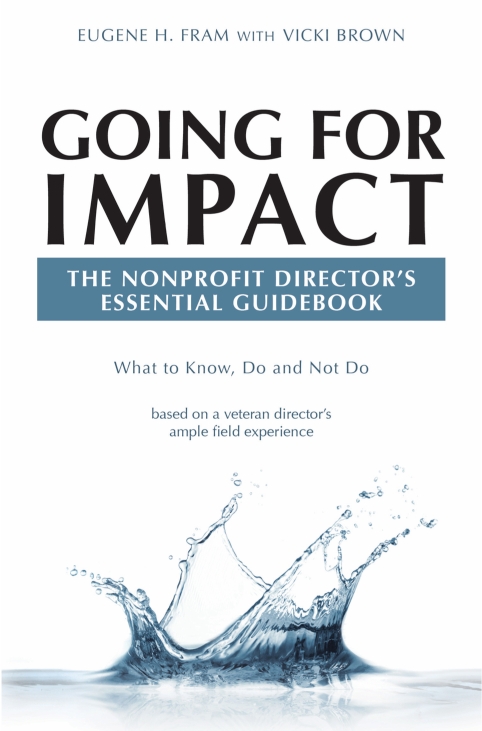
Improve Your Nonprofit Director Onboarding Process using Going For Impact

New guidebook covers

What to Know, Do and Not Do

As a veteran director with extensive experience on 12 nonprofit boards I have been “treated” to a wide variety of on-boarding sessions for new directors.

They’ve ranged from asking:

  • Every new director to read a 2.5 inch policy manual.  (I checked the size!)
  • Having experienced board members sit next to new ones at meetings.
  • Listening to the CEO review the entire policy manual.

Going For Impact: The Nonprofit Director’s Essential Guidebook lets you improve such sessions by making on-boarding governance material more meaningful and interesting. For example:

  • Use the book’s 150-item Index Strategically: Ask new directors to read specific topics (e.g., micromanaging; outcome vs. impact data; responsibilities of the board) and relate the readings to their new board.
  • Select Key Chapters in the Book: Choices include topics such as Nonprofit Culture Presents Challenges or There’s a Boundary Line That Shouldn’t Be Crossed. Then later – in either formal or informal sessions – have the CEO and/or board panels discuss the topics with the new directors.
  • Give All New Directors a Copy of the Book: Ask them to skim or read the book’s content, which encompasses 112 pages, and list topics of greatest interest.   Then hold three or four informal on-boarding sessions, led by experienced directors that relate to the selected topics.

Going for Impact can also be utilized by creative boards and CEOs to develop retreat agendas that can help enhance their board’s governance perspectives!

“Going for Impact” ©2016 https://goo.gl/Dwa9le